It's a fair question — can a single drop of blood from your fingertip really give a reliable omega-3 result? The short answer is yes, when the right method is used. Here's how at-home omega-3 testing works, how it compares with a clinic blood draw, and what separates a trustworthy result from a gimmick.
What's actually being measured
An at-home omega-3 test measures your Omega-3 Index — EPA plus DHA as a percentage of your red blood cell fatty acids. The finger-prick is just the collection method; the accuracy comes from how the sample is analysed in the lab, not from where the blood was taken.
Dried blood spot vs a venous draw
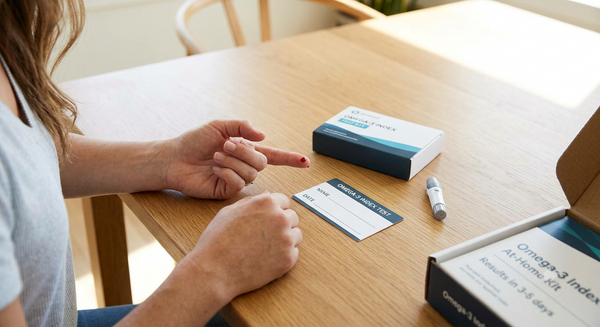
A home kit uses a dried blood spot (DBS): a few drops onto a collection card that you post back. This has been validated for fatty acid analysis in published studies, showing strong correlation (R² greater than 0.96) with the gold-standard red-blood-cell method from a venous draw. In other words, for the Omega-3 Index, a well-run dried blood spot gives results closely in line with a traditional lab blood test — without the clinic visit.
Why the method matters more than the needle
The decisive factor is the analytical technique. The reference method for fatty acids is gas chromatography with flame ionisation detection (GC-FID) — the same approach used in the published omega-3 research. It physically separates and quantifies each fatty acid, which simpler tests can't match. A finger-prick sample analysed by GC-FID is far more reliable than a venous sample run on a cruder method. You can read how this works on our method page.
Sample stability: why the post is fine
People often worry the sample will “go off” in transit. Fatty acids on a dried blood spot card are stable at room temperature for several weeks, which is precisely why the test can be posted across the UK without refrigeration. A few days in a postbox in summer or winter won't change your result.
What can affect accuracy — and how it's controlled
The main variables are collection technique (a good drop of blood, fully filling the card) and laboratory quality control. Reputable labs run calibrators and quality-control samples on every batch and review out-of-range results before release. The science behind the reference ranges is summarised on our science page.
How to judge a test's quality
- Does it report the Omega-3 Index on the recognised scale, not a vague “score”?
- Is the sample analysed by GC-FID?
- Is the method validated against the red-blood-cell reference, with quality control on every run?
- Is it analysed in an accredited laboratory?
If a test ticks those boxes, a finger-prick result is something you can act on.
Frequently asked questions
Is a finger-prick test as accurate as a blood draw?
For the Omega-3 Index, a dried blood spot analysed by GC-FID correlates very closely with the venous red-blood-cell reference method.
Will posting the sample affect the result?
No — fatty acids are stable on the card for several weeks at room temperature, so normal postal times are fine.
Do I need to fast before the test?
No. The Index reflects your status over the previous few months and isn't meaningfully changed by a recent meal.
What makes one omega-3 test better than another?
The analytical method (GC-FID), validation against the reference method, and per-batch quality control — not the brand on the box.
A lab-grade result, from a single finger-prick.
See our tests →References
- Harris WS, von Schacky C. The Omega-3 Index: a new risk factor for death from coronary heart disease? Preventive Medicine. 2004;39(1):212–220.
- Studies validating dried blood spot sampling against red-blood-cell fatty acid analysis (R² > 0.96).
This article is general information, not medical advice, and the test is not a diagnostic test. Always discuss significant health decisions with your GP.
Know your number.
A simple at-home finger-prick test, posted to your door. Find out where you actually stand on omega-3.
See our tests