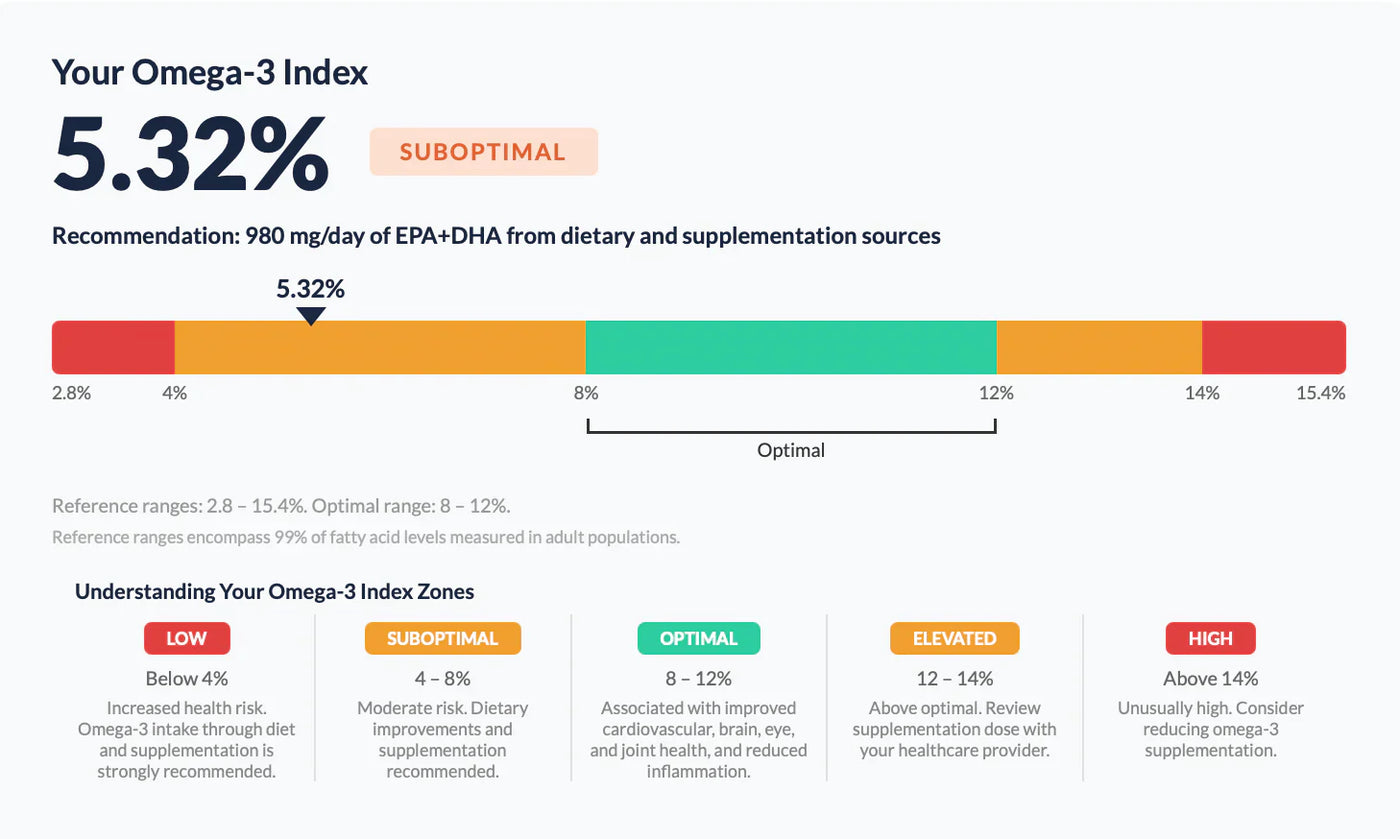
Your Omega-3 Index is one of the most useful health numbers you've probably never been given. It's a simple blood measurement that tells you whether you have enough of the two omega-3 fats — EPA and DHA — that research links most consistently to long-term heart and brain health. Here's what it measures, what counts as a healthy level, and why most people in the UK sit lower than they'd guess.
What the Omega-3 Index actually measures
The Omega-3 Index is the amount of EPA and DHA in your red blood cell membranes, expressed as a percentage of all the fatty acids there. It was defined by William Harris and Clemens von Schacky in 2004 as a more meaningful marker of omega-3 status than a one-off plasma reading — and it underpins the published evidence base behind the test. Because red blood cells live for around three to four months before they're replaced, your Index reflects your average intake across that window: a stable picture of your status, not a snapshot of yesterday's dinner.
Why EPA and DHA — not just ‘omega-3’
“Omega-3” is an umbrella term, and the differences matter. The plant form, ALA (found in flax, chia and walnuts), is technically an omega-3, but your body converts only a small fraction of it into the long-chain forms that build into your cell membranes. Those long-chain forms — EPA and DHA — are what the bulk of the clinical research is built on, and they're what the Index measures. EPA (eicosapentaenoic acid) is studied most for cardiovascular and inflammatory balance; DHA (docosahexaenoic acid) is a major structural fat in the brain and eyes.
The reference scale: low, suboptimal, optimal
Your result sits on a scale drawn from the research, not from marketing:
- Below 4% — the band associated with the highest cardiovascular risk in observational studies.
- 4–8% (suboptimal) — where most UK adults fall.
- 8–12% (optimal) — the desirable range Harris and von Schacky originally proposed as a target.
An Index of 8% was put forward as the level associated with lower risk of death from coronary heart disease. That makes the number more useful than simply asking “do you take a fish-oil capsule?” — it tells you where you actually are, on a scale that means something.
Why your number is so hard to guess
Two people eating what looks like the same diet, or taking the same supplement, can land on very different Omega-3 Index results. Absorption, the chemical form of the omega-3 (re-esterified triglyceride versus the cheaper ethyl ester), how much oily fish you genuinely eat, your genetics and even your body weight all change how much EPA and DHA reach your cells. This is the core reason testing beats assuming: a supplement label tells you what went in, not what your body did with it. If you want to work out a target dose, our guide to how much EPA and DHA you need walks through the numbers.
Where most UK adults sit
By international standards, the UK is an omega-3-low country. A global survey of blood omega-3 levels (Stark and colleagues, 2016) placed the UK and similar Western, low-oily-fish populations firmly in the lower bands — typically well under 8%. National diet surveys back this up: the Scientific Advisory Committee on Nutrition (SACN) and the NHS advise at least two portions of fish a week, one of them oily, yet most people don't manage even that. We've broken down where the UK really sits on omega-3 in more detail.
What a healthy level is linked to
In large observational studies, a higher Omega-3 Index has been associated with better cardiovascular and cognitive markers. It's worth being honest about that evidence: most of it shows association rather than proof of cause, and omega-3 is not a treatment for any medical condition. What the Index gives you is information — a way to know where you stand and make an informed choice with your GP, instead of guessing.
How to find out your Omega-3 Index
You don't need a clinic visit. A finger-prick dried blood spot, collected at home and analysed by gas chromatography (GC-FID — the reference laboratory method for fatty acids), gives you your Index on the same scale used across the research. You'll see your percentage, where it sits from low to optimal, and a personalised view of the EPA and DHA it would take to move it. Retesting after three to four months then shows whether what you changed is actually working. Here's how to read your result once it arrives.
Frequently asked questions
What is a good Omega-3 Index?
8–12% is considered the desirable range. Below 4% is the lowest band, and 4–8% — where many UK adults sit — is classed as suboptimal.
How is the Omega-3 Index measured?
From a small blood sample; a finger-prick dried blood spot is enough. It's analysed by gas chromatography with flame ionisation detection (GC-FID), the reference method for fatty acid analysis.
How often should I test?
Take a baseline, then retest after about three to four months if you change your diet or supplement — that's how long your red blood cells take to reflect the change.
Is the Omega-3 Index available on the NHS?
No. It isn't part of a standard NHS blood panel, which is why an at-home test is usually the practical way to find out yours.
Stop guessing — find out where you actually stand.
Check your Omega-3 Index →References
- Harris WS, von Schacky C. The Omega-3 Index: a new risk factor for death from coronary heart disease? Preventive Medicine. 2004;39(1):212–220.
- Stark KD, Van Elswyk ME, Higgins MR, et al. Global survey of the omega-3 fatty acids in the blood of healthy adults. Progress in Lipid Research. 2016;63:132–152.
- Walker RE, Jackson KH, Tintle NL, et al. Predicting the effects of supplemental EPA and DHA on the omega-3 index. American Journal of Clinical Nutrition. 2019;110(4):1034–1040.
- Scientific Advisory Committee on Nutrition (SACN) and NHS — guidance on fish and shellfish consumption.
This article is general information, not medical advice, and the test is not a diagnostic test. Always discuss significant health decisions, or any changes to medication or supplements, with your GP.
Know your number.
A simple at-home finger-prick test, posted to your door. Find out where you actually stand on omega-3.
See our tests