Your result is a single percentage, but what to do with it depends on how you eat now. Rather than repeat the theory, this guide works through three typical UK results: what each one means, what to change in everyday British food terms, and when to test again.
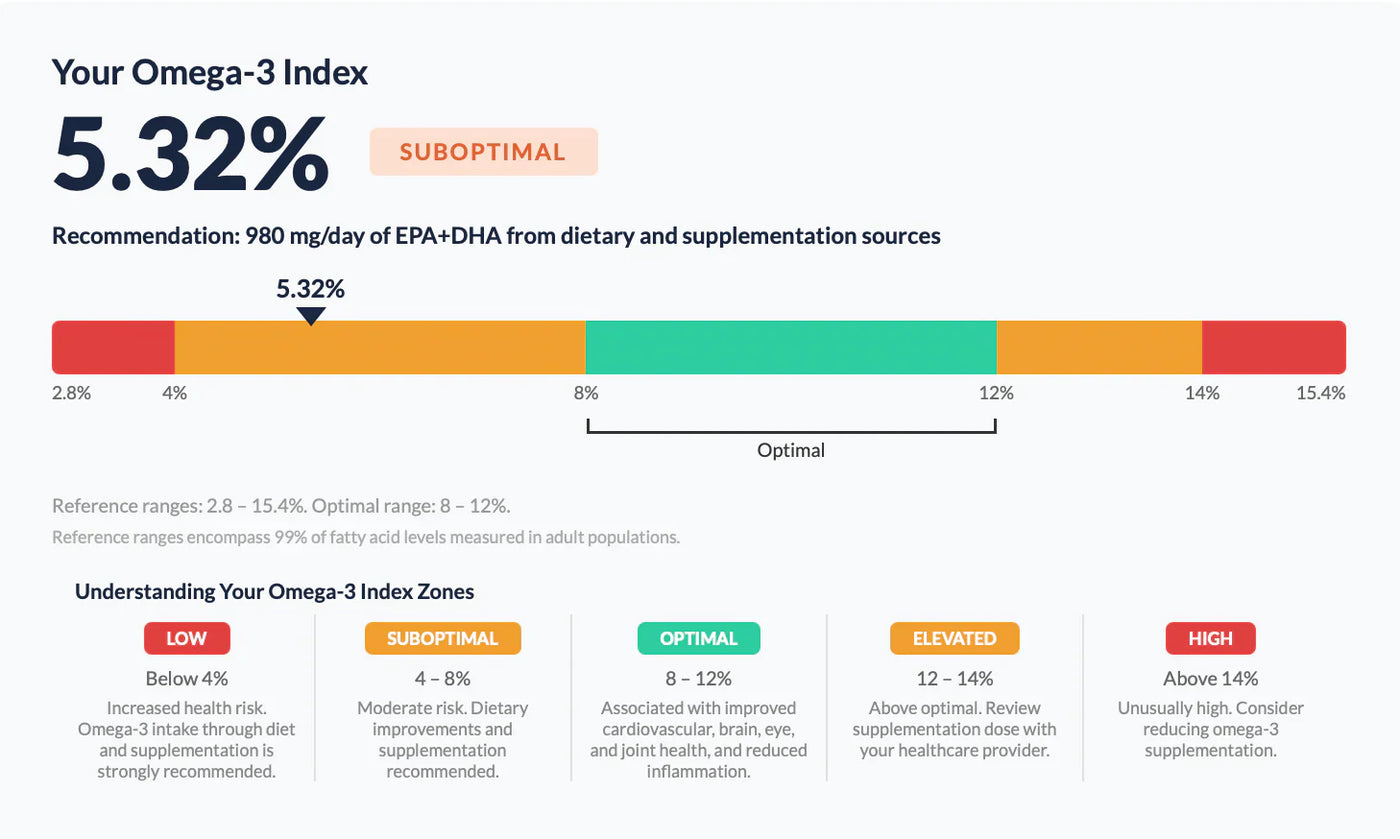
First, find your band
| Omega-3 Index | Band | In short |
|---|---|---|
| Below 4% | Low | The biggest gap to close |
| 4–8% | Intermediate | Where many UK adults sit |
| 8–12% | Optimal | The target range proposed in the research |
The Index is your EPA + DHA as a percentage of red blood cell fats, so it reflects roughly the last three to four months rather than last night's dinner. New to it? Start with what the Omega-3 Index is.
Example 1: 4.5%, "I don't really eat oily fish"
This is a common result for people whose fish comes mainly from the chip shop or tins of tuna, neither of which counts as oily fish in NHS advice. The quickest food change is to bring in a portion of oily fish each week: grilled mackerel, sardines on toast, a kipper at breakfast or a salmon fillet. Moving from 4.5% towards 8% is a big jump, so many people also consider a supplement. As a rough guide from research, each extra 1 percentage point takes around 370 mg of EPA + DHA a day over several months (Walker et al., 2019). If you're thinking about a higher-dose supplement, check with your GP or pharmacist first, especially if you take any medication.
Example 2: 6.2%, "salmon about once a week"
You're already doing what the NHS recommends for oily fish, which shows how the advice and the optimal range don't always line up. Options include a second oily-fish meal (within the NHS limit of four a week, or two if you're pregnant or planning to be), swapping some salmon meals for mackerel or sardines (often higher in EPA + DHA and cheaper), or a modest daily supplement.
Example 3: 8.4%, "I take a daily supplement"
You're in the optimal band. The job now is to keep doing what got you here. There's no clear evidence of extra benefit from pushing far above 12%, so don't chase a higher number. A yearly check is a reasonable rhythm, or sooner if you change your diet or supplement.
The extra numbers on Plus Ratios and Complete
If your test includes ratios, you'll also see your omega-6 : omega-3 ratio and AA : EPA ratio. Treat them as supporting context. Raising your EPA + DHA usually improves both at the same time. Our omega-6 to omega-3 ratio guide covers them in detail, and EPA vs DHA explains the split between the two.
Talking to your GP
The Omega-3 Index isn't part of routine NHS blood tests, so your GP may not have seen one before. The report is laid out like a standard results sheet, so it's easy to take along. It gives information, not a diagnosis. Bring it up if you're considering high-dose supplements, take blood-thinning medication, or have a heart condition. For what UK guidance says about the heart, see omega-3 and heart health in the UK.
When to retest
Red blood cells are replaced gradually, so a change builds up over several months. By about 3 months most of it shows, which gives a fair comparison; a retest much sooner will understate it. A practical plan is to test now, make one change, and retest after three months. Our twin packs (from £89.95) include a second kit for exactly that. Standard UK delivery is free, and OMEGA10 takes 10% off a first order.
Frequently asked questions
What's a normal omega-3 result in the UK?
There's no "normal" in the NHS sense because it isn't a routine test, but national data suggest many UK adults are in the 4–8% intermediate band. See UK omega-3 levels.
My Index is fine but my ratio is high. Which matters more?
The Omega-3 Index is the better-studied marker. Use the ratio as context.
Can I retest after a month?
You can, but you'll only see part of the change. Wait three months for a fair comparison.
Not tested yet? Get your baseline first.
See UK omega-3 tests →References
- Harris WS, von Schacky C. The Omega-3 Index: a new risk factor for death from coronary heart disease? Preventive Medicine. 2004;39(1):212–220.
- Walker RE, Jackson KH, Tintle NL, et al. Predicting the effects of supplemental EPA and DHA on the omega-3 index. Am J Clin Nutr. 2019;110(4):1034–1040.
- NHS. Fish and shellfish. nhs.uk.
This article is general information, not medical advice, and the test is not a diagnostic test. Talk to your GP before changing supplements or medication.
Know your number.
A simple at-home finger-prick test, posted to your door. Find out where you actually stand on omega-3.
See our tests