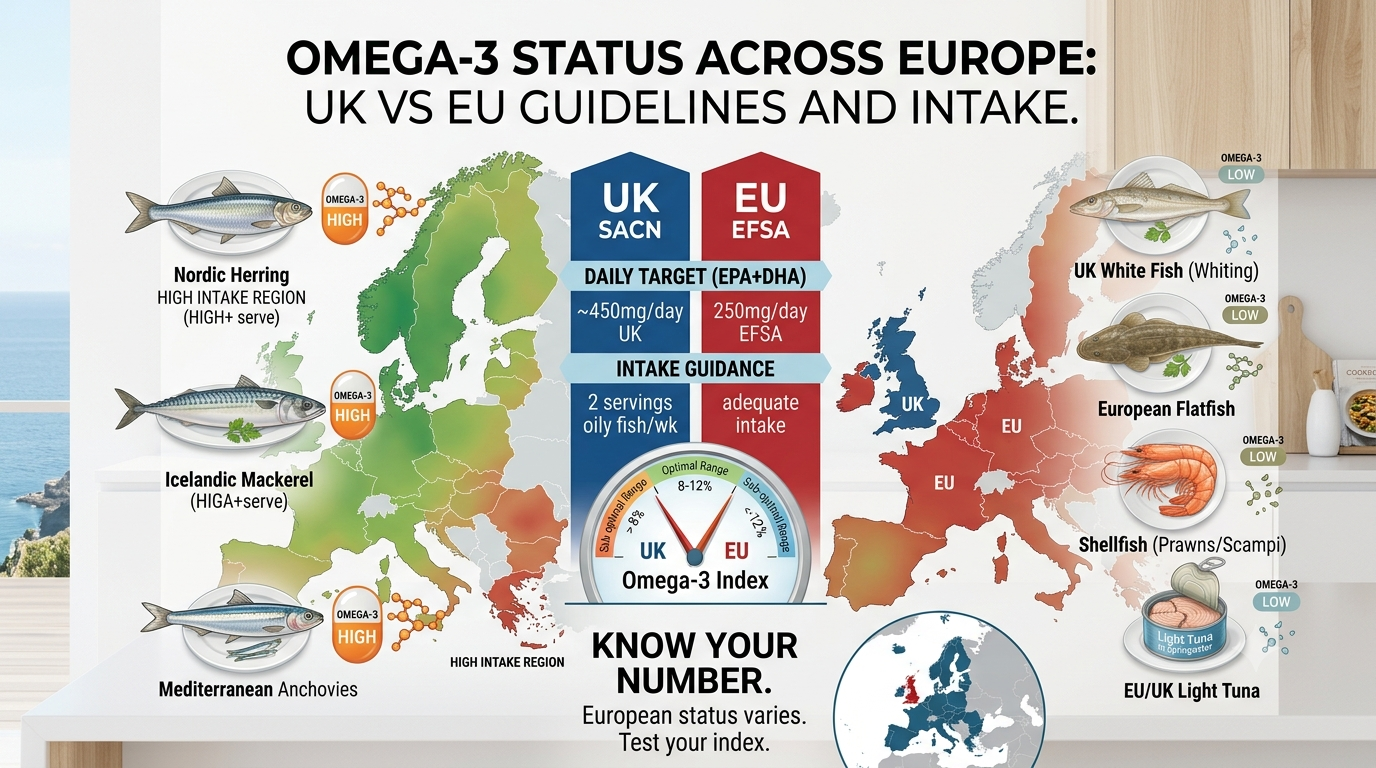
From the herring of Scandinavia to the anchovies of the Mediterranean, Europe is home to some of the world's great fish-eating cultures — and yet omega-3 status across the continent is far more patchy, and often lower, than you'd think. Here's how the UK compares with the rest of Europe on omega-3 guidelines, intake and actual blood levels — and what it means for your own number.
There is no single “European diet”
For omega-3, Europe is a continent of extremes:
- The Nordic countries (Norway, Iceland) have among the highest oily-fish and omega-3 intakes in the world.
- The Mediterranean (Spain, Portugal, Italy, Greece) has a strong tradition of small oily fish — anchovies, sardines — though modern diets are drifting away from it.
- Inland and northern Europe, including the UK, tend to eat far less oily fish, and sit in the low band of global omega-3 status maps.
In other words, omega-3 status can swing from world-leading to concerning within a few hundred miles. Where you live — and what you actually eat — matters more than the “European” label.
The guidelines: EFSA vs the UK's SACN
Two bodies shape the advice for most of Europe, and they broadly agree:
| EFSA (EU) | SACN / NHS (UK) | |
|---|---|---|
| Everyday target | 250 mg/day EPA + DHA (adequate intake for adults) | At least 2 portions of fish a week, one oily (~450 mg/day at population level) |
| Pregnancy | +100–200 mg/day DHA on top | Oily fish encouraged, within limits |
| Higher (therapeutic) intakes | 2–4 g/day for effects on blood pressure and triglycerides | Not a general recommendation |
The practical message from both is the same: a couple of servings of oily fish a week. The problem isn't the advice — it's the gap between the advice and what most Europeans actually do. Our guide to how much EPA and DHA you need breaks the numbers down further.
Where Europe actually sits
The landmark global survey by Stark and colleagues (2016) mapped blood omega-3 levels across populations worldwide. For Europe, the headline is wide variation: Scandinavian and some coastal populations sit in the higher bands, while much of the rest of Europe — the UK included — sits low to very low, well beneath the 8–12% Omega-3 Index that research links to better cardiovascular and cognitive outcomes.
The UK's own position is covered in more detail in where the UK really sits on omega-3 — and it isn't flattering.
Why “eat more fish” isn't landing
- Oily-fish consumption is falling across much of Europe, especially among younger people.
- Farmed fish now carry less omega-3 than they did a decade or two ago, as feed formulations have changed.
- Individual absorption and metabolism vary enormously — two people eating the same diet can end up with very different levels.
So the population advice can be perfectly sound and your personal level can still be low. That's the crucial thing guidelines can't capture.
What this means for you
Guidelines are population averages. They tell a health ministry what to recommend; they can't tell you where you personally sit. The only way to know that is to measure your Omega-3 Index — the EPA + DHA in your red blood cells, on the same scale used in the research behind these very guidelines. It isn't part of a standard NHS or GP blood panel, which is why an at-home test is the practical way to find yours.
Frequently asked questions
Is the “right” target 250 mg (EFSA) or 450 mg (UK)?
Both are population guides rather than personal prescriptions. EFSA's 250 mg/day is a minimum “adequate intake” for basic cardiac function; the UK's two-portions advice works out higher. Aiming for the higher end is reasonable for most people — but your blood level is what actually reflects whether you're there.
I live in a fish-eating country — am I fine?
Not necessarily. National averages hide big individual differences, and even in high-intake countries plenty of people sit low. The only way to be sure is to test.
Stop guessing where you sit on Europe's omega-3 map — measure it.
Check your Omega-3 Index — from £49.95 →References
- European Food Safety Authority (EFSA). Scientific Opinion on Dietary Reference Values for fats (2010); Tolerable Upper Intake Level for EPA, DHA and DPA (2012).
- Scientific Advisory Committee on Nutrition (SACN) / NHS. Advice on fish consumption.
- Stark KD, et al. Global survey of the omega-3 fatty acids in healthy adults. Progress in Lipid Research. 2016;63:132–152.
- Harris WS, von Schacky C. The Omega-3 Index: a new risk factor for death from coronary heart disease? Preventive Medicine. 2004;39(1):212–220.
This article is general information, not medical advice, and the test is not a diagnostic test. Always discuss changes to diet, supplements or medication with your GP, particularly in pregnancy.
Know your number.
A simple at-home finger-prick test, posted to your door. Find out where you actually stand on omega-3.
See our tests