When people say "omega-3", they almost always mean EPA and DHA — the two long-chain omega-3 fats found in oily fish. They're the ones behind most of the research on omega-3 and your heart, brain and eyes. Here's what EPA and DHA actually are, where to get them, how much you need, and how to check whether you have enough.
What are EPA and DHA?
EPA and DHA are two essential omega-3 fatty acids — "essential" because your body can't make them in useful amounts, so you have to get them from your diet.
- EPA — eicosapentaenoic acid. A 20-carbon omega-3 mainly involved in signalling, particularly around inflammation.
- DHA — docosahexaenoic acid. A 22-carbon omega-3 that's mainly structural — it's built into your cell membranes, most heavily in the brain and the retina of the eye.
There's a third omega-3 you'll see on labels, ALA (alpha-linolenic acid), from plant foods like flax, chia and walnuts. It's technically an omega-3, but your body converts only a small fraction of ALA into EPA (typically under 10%) and very little into DHA — which is why EPA and DHA from fish or algae matter most.
Where do EPA and DHA come from?
Preformed EPA and DHA come almost entirely from the sea:
- Oily fish — salmon, mackerel, sardines, herring, trout and anchovies are the richest sources.
- Fish oil and cod liver oil supplements.
- Algae oil — the original source (fish get their omega-3s from eating algae), and the go-to option for vegans and vegetarians. See our guide to plant-based and vegan omega-3.
The UK's SACN and the NHS recommend at least two portions of fish a week, one of them oily — but national surveys show most people in the UK eat far less than that, which is a big reason the average Briton sits in the low band for omega-3.
EPA vs DHA: what each one does
| EPA | DHA | |
|---|---|---|
| Main role | Signalling & inflammation balance | Cell-membrane structure (brain, eyes) |
| Most studied for | Heart health, mood | Pregnancy, infant brain & eye development, cognition |
| Concentrated in | Blood, platelets | Brain, retina |
They're not interchangeable, but they work together — and most fish and supplements provide both. For a deeper look, read EPA vs DHA: what's the difference?
Why your EPA and DHA levels matter
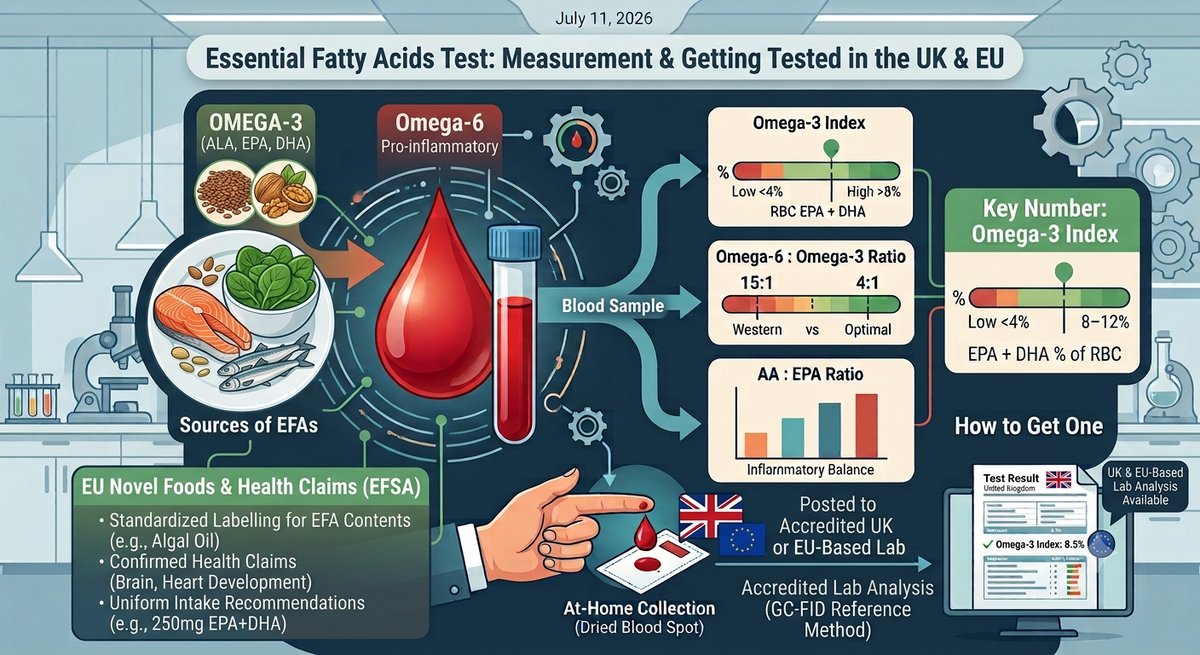
Here's the catch: you can't feel your omega-3 status, and it isn't on any routine NHS blood panel. Two people eating "the same" diet or taking "the same" supplement can end up with very different EPA and DHA levels — because dose, consistency, absorption and genetics all vary. And because these fats build up in your red blood cell membranes over about three to four months, the only reliable way to know where you stand is to measure them.
How much EPA and DHA do you need?
For general health, guidance points to roughly 250–500 mg of combined EPA + DHA per day — about two portions of oily fish a week. If you're starting from a low level and want to reach the optimal Omega-3 Index range, the amount is usually higher and depends on where you begin. Our guide to reading your result and the dose calculator walk through the numbers.
How to check your EPA and DHA
You don't need a GP referral or a clinic visit. An at-home omega-3 test kit uses a simple finger-prick: you post a dried blood spot to the lab, and it's analysed by GC-FID — the reference method for fatty acid analysis. You get back your EPA and DHA, your Omega-3 Index on the 8–12% scale, and a personalised dose, all in plain English. (Wondering how accurate at-home kits are? Here's our honest answer.)
Find out your EPA and DHA level
A simple at-home finger-prick test kit. Analysed by GC-FID, results in 3–5 days. Free UK & Europe shipping.
Order the Omega-3 Index test — £49.95 →References
- Harris WS, von Schacky C. The Omega-3 Index: a new risk factor for death from coronary heart disease? Preventive Medicine. 2004;39(1):212–220.
- Scientific Advisory Committee on Nutrition (SACN). Advice on fish consumption: benefits and risks. UK Government.
- Stark KD, et al. Global survey of the omega-3 fatty acids in healthy adults. Progress in Lipid Research. 2016;63:132–152.
This article is general information, not medical advice, and does not diagnose, treat or prevent any condition. Discuss dietary or supplement changes with your GP, especially in pregnancy or if you take medication.
Know your number.
A simple at-home finger-prick test, posted to your door. Find out where you actually stand on omega-3.
See our tests